Here's What's New in Solvi

Follow up on the latest improvements and updates. Missing a feature or want to suggest an improvement? Let us know!

Vegetation Indices

New: Index Library in Solvi 📚

We’ve just released a new feature in Solvi that gives you full control over which vegetation indices you use.

Until now, Solvi came with 10 default indices. If you needed something else, our team had to add it manually. That worked, but it wasn’t ideal.

With the new Index Library (available in the top menu), you can now:

• Browse 50+ additional indices and add any of them to your account with a single click
• Create completely custom indices from scratch by entering a name and formula
• Use your indices across all tools, Plant Health maps, Zonal Statistics, and PlantAI

Creating a custom index is simple. Just type in the formula using band variables (R for red, N for NIR, E for red edge, G for green), and it’s validated instantly with a live preview on the map.

Any index you add is saved to your account, so your whole team can use it too. Index Library is available to Professional and Enterprise plan users.

Curious to see how it works? Watch the video below 👇

Introducing the New Compare Tool 🚀

We’re excited to introduce the new Compare Tool, a new way to explore and analyze your drone data in Solvi!

The Compare Tool lets you view and compare different datasets, layers, or flight dates side by side — helping you spot changes, validate results, and better understand crop development or treatment effects over time.


Two comparison modes

• Split View – Displays two layers on a single map, separated by a draggable slider. Perfect for comparing two vegetation indices or seeing changes in the same field between flights.

• Side-by-Side View – Shows two synchronized maps side by side.
As you pan or zoom one map, the other follows automatically — ideal for comparing different dates or datasets with precision.


How it works

    1. Choose the dataset you want to view on the map.
    1. Toggle on the Compare Tool.
    1. Select the dataset or flight date to compare with.
    1. Choose which data layer to display — for example, an Orthomosaic, Elevation, Plant Counts, Plant Health, or Zonal Statistics.
    1. Select which metric to compare, for example vegetation index or any plot-level metric.

Whether you’re analyzing vegetation indices (like NDVI vs. NDRE) or tracking trial performance across dates, the Compare Tool makes visual comparisons faster and clearer.


The new Compare Tool is available now in all Solvi accounts.

Feel free to give it a try and let us know what you think! 🚀

Zonal Statistics
PlantAI
API

Update to Map Editing Tools in Zonal Statistics and PlantAI

We’ve rolled out a new update focused on improving how you interact with maps and plots inside both Zonal Statistics and PlantAI tools. These changes make it faster and more intuitive to define plots, adjust areas, and fine-tune detection zones for your analyses.


Zonal Statistics Updates

The map editing tools in Zonal Statistics have been redesigned to match the familiar layout from PlantAI. You’ll now find the editing tools conveniently located in a sidebar on the right-hand side of the screen.

In addition to this layout change, we’ve introduced two new editing features:

  • 📐 Rectangular plot drawing tool – Quickly create rectangular plots for faster trial setup.
  • Resizing tool – Adjust width and height independently, giving you precise control over plot dimensions.

These updates make it easier to standardize plot shapes and sizes across your field trials.


PlantAI Updates

In PlantAI, we’ve expanded the flexibility of detection area editing. You can now:

  • ✂️ Cut detection areas into multiple
  • ◎ Create holes inside polygons

This means if a field includes an area that should be excluded from analysis (for example, a non-crop patch or an obstacle), you can now simply cut a hole and exclude it from detection.


Other Improvements and Fixes

  • Basic counts can now be exported as both points and bounding boxes.
  • Fixed an issue in automatic plot detection where duplicate plots could sometimes appear at the start of a trial area.
  • API improvements:
     – New endpoint to fetch all transactions within an account.
     – Added the ability to search for projects by date.
     – Project details now include number of images, bands, cropped crop, and flight altitude, among other metadata.

We would like to thank our users for all the feedback on improvements that they’ve provided, including these updates.

Do you have any other ideas on how we can improve? Don’t hesitate to let us know!

Prescription Maps

🚜 Major update to the Prescription Tool

We’ve made a major update to the Prescription Tool, making it easier than ever to create variable rate application maps directly from your drone imagery.

Until now, the tool supported only vegetation index–based prescriptions — a great fit for fertilizer applications in broadacre crops.

With this update, the Prescription Tool now works with PlantAI outputs, unlocking new use cases across weed management and specialty crop nutrition.

Here’s what’s new:

1. Create prescriptions from PlantAI data
Use plant size, density, or canopy cover from Plant AI analyses as input for your prescriptions. This enables precision fertilizer management in specialty crops and supports spot spraying based on weed detections.

2. Flexible grid design
You can now customize grid layout to match your machinery. Rotate the grid to align with tramlines, set individual cell width and height, and define the working width to match your sprayer or spreader.

3. Support for more file formats
In addition to the standard shapefile export, you can now generate prescription files in several vendor-specific formats — including John Deere, DJI Agras, and Hardi GeoSelect — with more options coming soon.

Example use cases:

  • Variable-rate fertilization using vegetation indices such as GLI or NDVI to balance crop vigor.
  • Fertilizer optimization in lettuce using average plant diameter from Plant AI to help smaller plants catch up.
  • Spot spraying in sugar beet using weed detections to target only infested areas significantly cutting chemical use.

Give the new Prescription Tool a try and see how it fits into your workflow!

PlantAI

🌱 PlantAI Gets Smarter and Faster

We’ve rolled out a big upgrade to PlantAI, making plant detection more powerful, flexible, and easier to use.

Here’s what’s new:

  • Three Detection Modes
    Choose between Basic, Plant-level Data, or the brand-new Weed Detection mode for more targeted insights.

  • Smarter Examples
    Provide just three examples of plants, and PlantAI will automatically suggest the optimal box size—no need to guess.

  • Faster Annotations
    Use the new AI-powered Magic Wand to speed up marking.
    Reuse results from previous detections as ready-made annotations.

  • Live Updates
    Watch detections happen live with instant progress updates.

  • Notes & Markers
    Drop notes directly in the field view to flag spots for review or future annotation improvements.

  • Filter Out False Positives
    Fine-tune results with a probability score filter to remove objects detected by mistake.

Curios to see how it works? Watch the walkthrough in the video below:

More colors in Zonal Statistics! 🌈

The first update of the year brings a splash of color to Zonal Statistics!

We’ve made it easier than ever to customize the look and feel of your zones:

Flexible Classification: Choose any number of classes for your plots.

New Color Schemes: Select from 5 new color schemes, with the option to invert colors.

New Classification Modes: Classify your stats using equal intervals, equal count, or natural breaks.

Custom Opacity: Make zones fully transparent or set your preferred opacity.

And the best part?

All your settings in Zonal Statistics are now automatically remembered and reused in future datasets.

Fewer clicks, more analytics! 🚀

Zonal Statistics
Plant Focus
Elevation maps

December Update

This last update of 2024 brings a few improvements:

  • Improved performance in Plant Focus - navigating the map with Plant Focus turned on could often get slow, but not anymore. We have improved the rendering of the vegetation masks for better and smoother navigation.
  • Second slider for max values in Plant Focus - it is now possible to create vegetation masks by filtering out values beyond the max threshold. It can be useful for example for filtering out soil pixels using thermal imagery.
  • Custom percentiles in Zonal Statistics - custom percentile options, from 5 to 95 percentiles can now be chosen in addition to previously available 25 and 75 percentile options.
  • Better management of custom attributes in Zonal Statistics - when zones with custom attributes are imported from a SHP-file, the data types of the attributes are now preserved all the way to the export of the statistics. In addition, the styling of custom attributes should now be more consistent.
  • Updated component for choosing and creating Fields - the old component where fields could be both chosen and created within the same dropdown was quite confusing. It’s now replaced with a dropdown for selection of the Fields and a separate button to create new ones.
  • Export of Canopy Height Models - CHM can now be downloaded as GeoTIFF or JPEG, similar to the DSMs

Merry Christmas and Happy New Year! 🎄🎄🎄

Zonal Statistics
Elevation maps

🚀 The new Elevation tool is here!

We are excited to release a major update to the Elevation tool that now features:

  • New dynamic map rendering - you can now choose how to colour-classify different elevation values, similar to the Plant Health maps
  • Create Canopy Height Model using manual reference points or a DTM created in the early pre-emergence growth stages
  • Use Canopy Height Model to calculate height of the crops in the Zonal Statistics tool
  • Upload your own DSM, for example one created from LiDAR data for better accuracy

See how it works in practice:

Zonal Statistics
Exports

Custom coordinate systems in exports, improved display of units in Zonal Statistics, and more

In this update, we bring you a few new features and updates:

  • Support custom coordinate systems for raster exports : Orthomosaics, Elevation and Plant Health maps can now be downloaded in custom coordinate systems. UTM is used as a default.
  • It is now possible to delete Farms that don’t have any uploads.
  • For users in an Organisation access can now be managed on the Farm-level
  • Full and more descriptive attribute names are now displayed in Zonal Statistics CSV exports
  • Zonal Statistics can now be downloaded in Geopackage format
Zonal Statistics

The all-new Trial Plot Creation Tools is here

We are excited to release a major upgrade to the Trial Plot Creation Tools!

This new update includes:

  • New workflow for plot generation - mark corners of the whole trial, specify number of rows and columns (or plot dimensions) and gaps, and the plots will be generated for the whole trial automatically
  • Possibility to choose which side of the trial area is rows and which is columns
  • More flexible naming of the plots
  • Possibility to import plots from Excel - for every cell in the Excel file that has value, a plot will be created and cell’s value will be used as plot ID

See how it works:

Zonal Statistics

September Update

In this update we released a few minor improvements:

  • Declutter plot labels in Zonal Statistics in outer map zoom levels
  • Plot labels now always keep horizontal orientation, even when the map is rotated
  • In fields with multiple uploads, “View map” button on the field card is always visible, even if there is an ongoing upload so that previous uploads can be accessed
  • Non-NADIR images that the DJI drones have at some point started taking after the mission is completed are now automatically removed from the upload to avoid potential stitching issues
  • Improved generation of the PDF-reports to avoid cases when some parts of the map were not rendered
  • Add support for thermal imagery from DJI Mavic 2 Enterprise Advanced
Density Maps
PlantAI

June Update

Density Maps

In this update we bring you a new feature - Density Maps, and a few improvements:

  • Density Maps can now be created for Plant Counts. Choose the grid size and direction of the rows and plant density (plants per hectare or acre) will be calculated for the whole field
  • Enterprise users - custom vegetation indices are now available for the whole Organisation so all users, including new ones, automatically get access to all indices
  • Opt in to get notified when a PlantAI detection has finished processing
  • Histogram range in the Plant Focus tool can now be “zoomed in” for better accuracy
Plant Focus

Plant Focus: a New Tool for More Accurate Plant Health Analysis

Plant Focus

We are excited to introduce a new tool - Plant Focus!

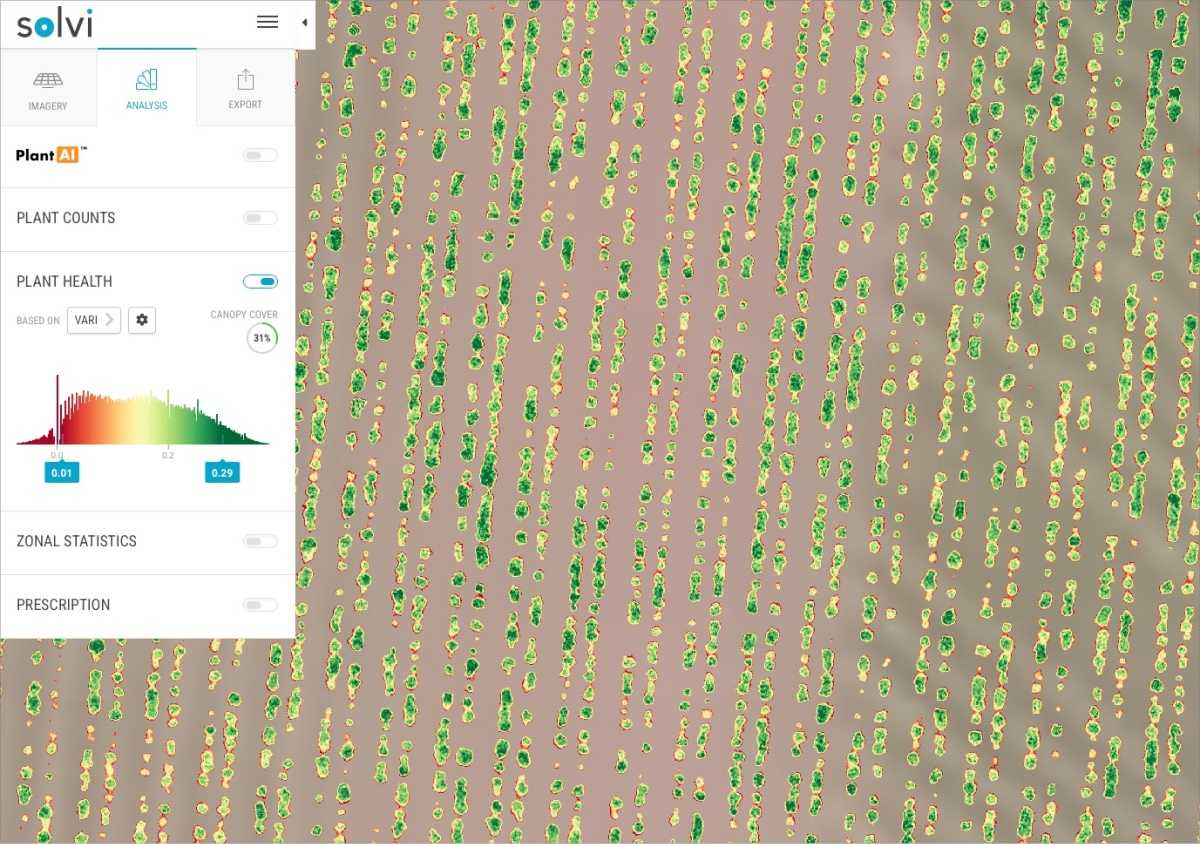
With Plant Focus, you can can remove unwanted parts of the imagery, like soil or weds, from the analysis so that Plant Health maps and Zonal Statistics only use crop data.

This is achieved by creating Vegetation Masks using one of the approaches:

  • Vegetation Index: Use any vegetation index, such as NDVI or VARI, in the early growth stages to distinguish crops from soil by choosing the appropriate index threshold
  • PlantAI Detections: Utilize PlantAI detections to separate crops from other vegetation like weeds or grass between the rows

Learn more about Plant Focus in this article.

Thermal Imagery

February Update

In this update we improved support for thermal imgery:

  • Single-band thermal orthomosaics (in centikelvin format) can now be uploaded
  • RGB and Thermal images from DJI Mavic 3T can be uploaded together. Higher-resolution RGB will be used for stitching and displayed as default map layer. Thermal imagery can be visualized in the Plant Health tool and used for thermal stats calculation in Zonal Statistics